What to Check Before Paying for an Imported Phone

On this page
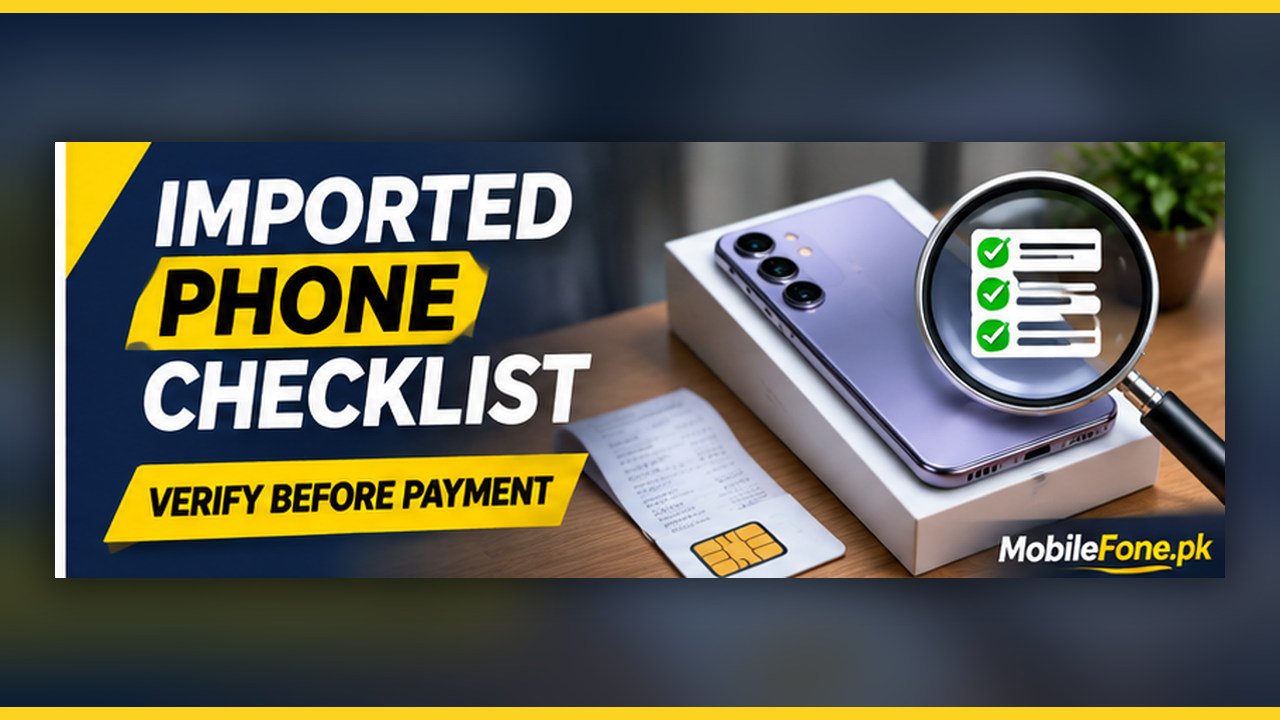
Before buying an imported phone in Pakistan, verify its exact IMEIs, local network eligibility, account-unlock status, model variant and final cost. A phone that turns on, connects to Wi-Fi or makes a brief call is not automatically a safe purchase. Ask the seller to demonstrate the device’s status through the official PTA verification process while you are present, and record what is included in the price. Do not pay extra for a verbal promise that registration will be arranged later.
Verify the handset and every IMEI yourself
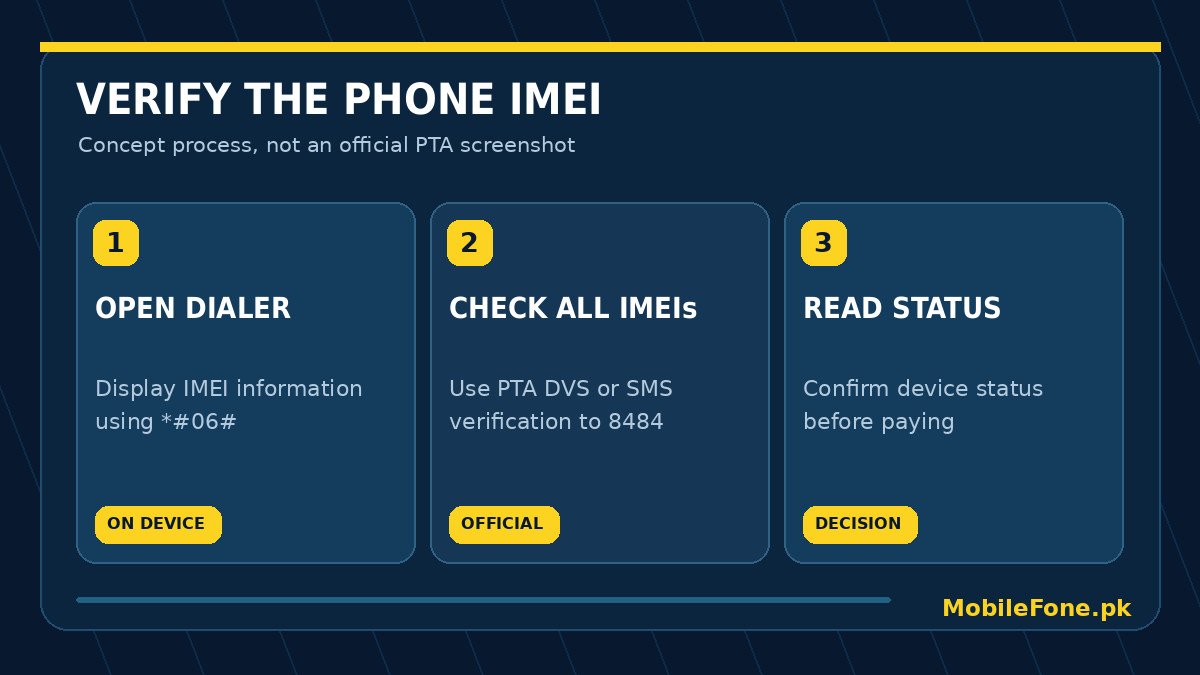
Open the phone’s dialler and enter *#06# to display the IMEI information, then compare each relevant number with the box and receipt. Dual-SIM or other multi-IMEI devices can have more than one identifier. The PTA’s Device Verification System allows a buyer to check IMEI compliance, including by sending the IMEI number to 8484 or using the official DVS application. The formal details appear in the PTA DIRBS standard operating procedures and associated verification channels.
- Ask the seller to show the IMEI on the phone itself, not merely a photo or the box.
- Check each reported IMEI through an official PTA/DVS method and read the actual response.
- Compare the handset model and SIM configuration with the box, receipt and advertised listing.
- If a status is unclear or non-compliant, pause the purchase until its implications are documented.
- Record the verified IMEI on your invoice only if you are comfortable with the seller’s privacy and paperwork practices.
A seller may say that the handset is patched, server-approved or permanently approved without an official status. None of those phrases replaces a live check of the device’s actual IMEI record. Avoid altered identifiers, SIM workarounds and instructions to bypass registration. If the seller refuses to show the device’s IMEI, a low asking price is not a reason to continue.
Understand PTA status, duties and the real cost
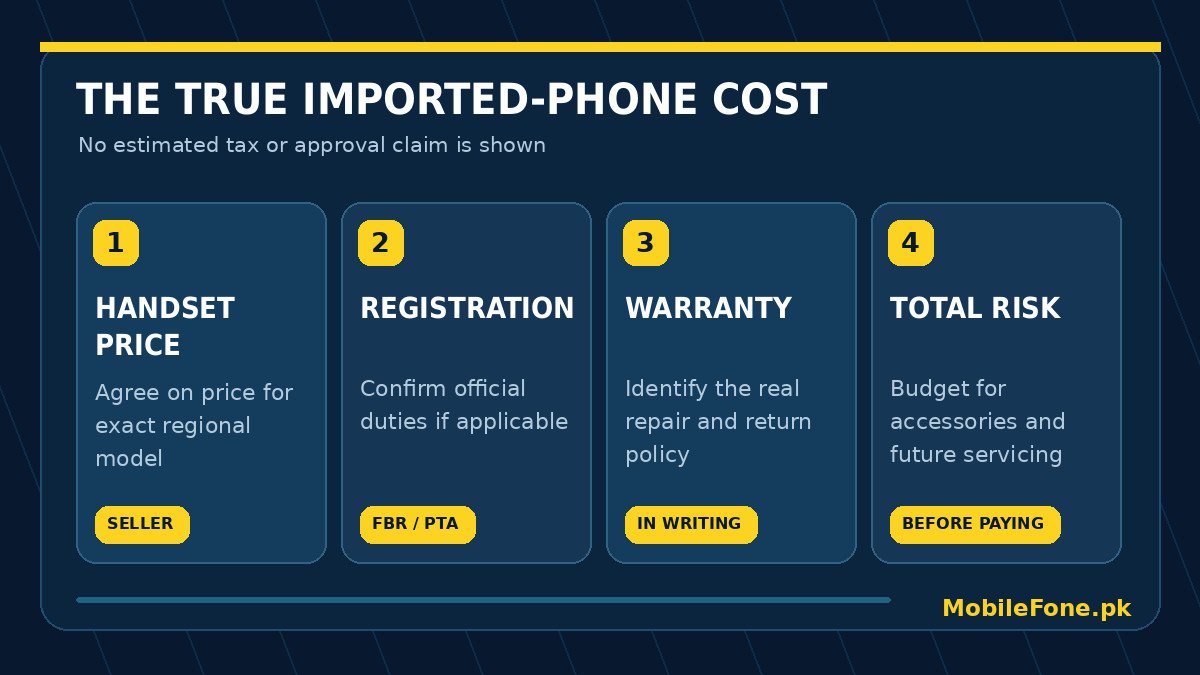
Imported phones can involve tax and registration costs that differ by model, route of import and the rules applying to the buyer. Pakistan’s Federal Board of Revenue DIRBS guidance directs importers and travellers to the official procedure and duty information. Do not treat an old online calculator, an advertised phone price or a shopkeeper’s estimate as a current government assessment. The relevant figures should come from the applicable official process for that specific device.
| Seller statement | Evidence to request | Buying decision |
|---|---|---|
| PTA approved | Check every IMEI via official DVS | Proceed only if other checks pass |
| Tax will be paid later | Current official payment/registration route and who pays | Do not rely on a verbal future promise |
| International warranty | Written terms and actual eligible service location | Budget for limited local support |
| SIM works today | Official status plus repeated call/data tests | Temporary functionality is not compliance proof |
| Factory unlocked | Test a local SIM and verify network-lock settings | Reject unexplained carrier restrictions |
Build the total purchase budget from the handset price, any officially required device registration or duties, compatible charger, local repair or warranty risk, and delivery or return charges. If an international or region-specific model costs less but leaves you responsible for major servicing, the advertised discount may disappear quickly. For a reference point, compare local offerings in the MobileFone under-Rs. 50,000 directory without assuming every listed product has the same import or warranty terms.
Check variant, radios, SIM and software
Two phones sold under the same marketing name can differ in supported network bands, physical SIM slots, eSIM availability, storage, regional software and supported languages. Check the exact model number in Settings, then compare it with the manufacturer’s regional specification rather than a generic retailer description. Verify the seller’s claim about eSIM with your chosen operator; a menu label alone does not guarantee provisioning is available on your particular account and plan.
Insert a valid local SIM with the seller’s permission and make a normal call, send a text where appropriate, and test mobile data away from store Wi-Fi. Check that the handset is not carrier-locked and that its radio bands meet your needs. If your area depends heavily on one operator, test that operator if possible. A device can be legitimate yet have disappointing coverage because its regional hardware or carrier configuration differs.
Account locks, repairs and physical condition
On a used iPhone, make sure the previous owner has removed Activation Lock before money changes hands. Apple’s pre-owned iPhone buying instructions explicitly warn against buying an iPhone that remains locked to someone else’s account. For Android, confirm the seller has removed their accounts and that the device can be set up without an unknown former owner’s credentials. Do not attempt account-lock bypass tools or secret repair-menu sequences.
Inspect the display for touch gaps, uneven brightness and replacement marks. Test the camera, microphone, speakers, biometrics, USB port and charging. Look for moisture indicators or visible corrosion only where a manufacturer documents safe inspection; do not disassemble a sealed phone. Check that any warranty is written with a real local claim process. A shop warranty, international manufacturer warranty and official Pakistan warranty are not interchangeable.
A receipt should identify the exact physical handset, not just its retail brand name. Ask for a reasonable period to inspect the phone and test both network functionality and charging. If the seller says the imported phone is new, confirm whether the packaging was previously opened for registration or testing, and examine any inconsistencies between the claimed condition and the device. A quick search in the broader mobile model catalogue can help you see whether the storage and software variant being offered matches the phone you intended to buy. This does not replace official model documentation or PTA verification.
A sensible payment and receipt checklist
- Identity: actual model number, storage and every IMEI verified on the handset.
- Compliance: official PTA/DVS response viewed during inspection, with unresolved issues cleared before paying.
- Function: local SIM call, data, cameras, charging, speakers and account unlock tested.
- Money: total price and responsibility for any registration, tax or servicing written down.
- Paperwork: seller details, dated invoice, serial/IMEI reference and clear return conditions.
An imported model may be worthwhile for a specific feature or storage variant, but the safest deal is one whose status you can verify immediately and whose full cost is clear. You can browse 256GB phone alternatives to compare features before deciding that an imported unit is the only sensible choice.

Related reading
 Mobile Buying GuidesMobile Buying Checklist for Pakistani BuyersNovember 14, 2026
 Mobile Buying GuidesHow to Inspect a Used Samsung Phone Before BuyingNovember 14, 2026
 Mobile Buying GuidesHow to Inspect a Used iPhone Before BuyingNovember 14, 2026
 Mobile Buying GuidesRefurbished vs Used vs Open-Box PhonesNovember 14, 2026