What Is LTPO Display Technology?

On this page

LTPO is a display backplane technology used in some OLED smartphone screens to support efficient, variable refresh rates. It helps a compatible display refresh rapidly while you scroll and more slowly when showing content that hardly changes. That flexibility can reduce unnecessary screen power use without sacrificing smooth motion. But an ‘LTPO 120Hz’ label does not tell you the actual brightness, color accuracy, battery endurance or minimum refresh rate of every phone.
What changes inside an LTPO screen?
A display refresh rate tells you how many times per second the panel updates its picture. A 120Hz screen can refresh up to 120 times each second, which can make scrolling and some animations look smoother than 60Hz. Static text does not need that many updates. LTPO helps manufacturers build OLED panels that adapt their behavior to what is happening on-screen instead of using a fixed rate all the time.
The initials are commonly expanded as low-temperature polycrystalline oxide. In practice, LTPO combines transistor technologies in the screen’s backplane to support low-leakage operation and flexible refresh control. Samsung Display’s explanation of its HOP technology describes a hybrid that uses oxide switching transistors and low-temperature polysilicon driving transistors. This is an example of LTPO implementation rather than a universal specification sheet for every LTPO-branded phone.
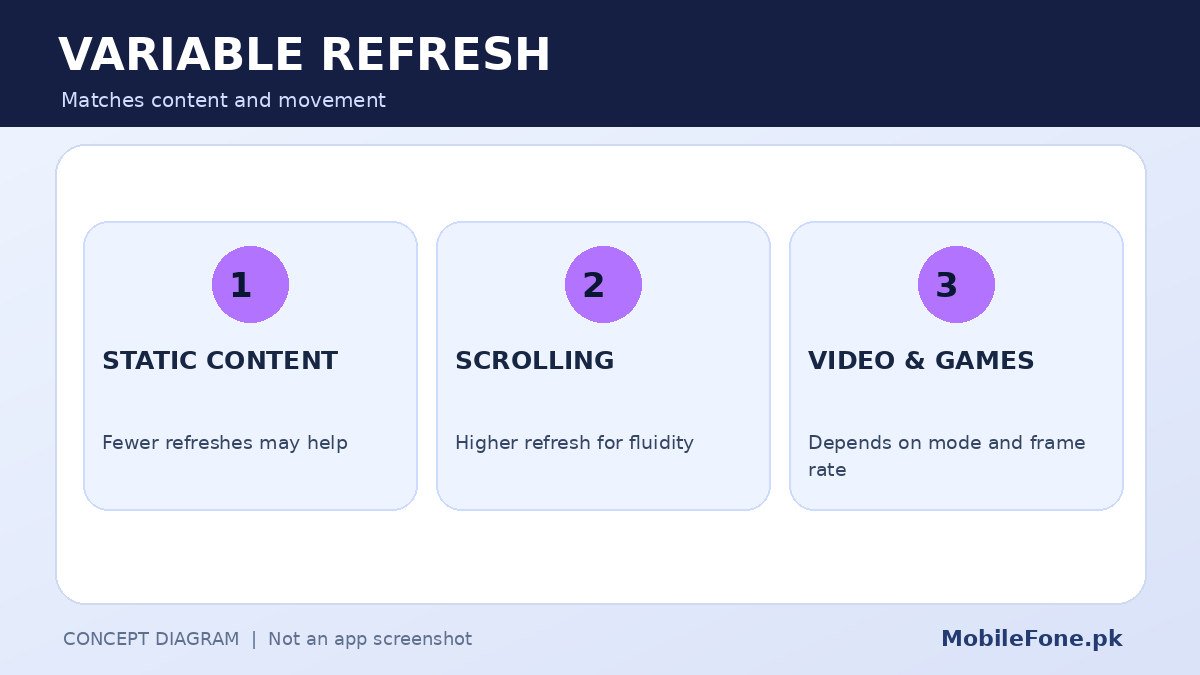
| Content | Typical display need | Why it matters |
|---|---|---|
| Static photo or always-on information | Relatively few updates | Can avoid wasted refresh work |
| Reading a still webpage | Low rate while motion stops | Less frequent redraws may save power |
| Standard video | Match content and system behavior | Avoid unnecessary high-rate operation |
| Rapid scrolling | Higher refresh rate | Smoother apparent movement |
| Compatible fast games | High rate when supported | Potentially more fluid motion |
Why LTPO is often mentioned with 1Hz and 120Hz
Phone makers commonly promote a wide adaptive range such as 1–120Hz, but the actual minimum, maximum and intermediate steps depend on the panel, controller and software. Samsung Display’s public examples illustrate 120Hz for fast motion, 60Hz for ordinary video and 10Hz for images. Those are examples of how adaptive refresh works, not a guarantee that every LTPO phone uses exactly those values in every application.
A screen may change refresh frequency automatically when you stop scrolling, switch apps or enable an always-on clock. Some products restrict the lowest rates to certain brightness levels or modes. Others use different limits while recording, gaming or interacting with a stylus. Check official claims for the specific model rather than treating LTPO as one fixed set of behaviors.
Readers comparing current premium displays can start with MobileFone’s recent phone directory, then verify the panel details and refresh-rate range from the manufacturer. A product listing that simply says ‘120Hz AMOLED’ may not reveal whether the panel uses LTPO at all.
Does LTPO automatically improve battery life?
Reducing unnecessary refreshes can help display power efficiency, particularly when the user spends time reading or looking at relatively static content. That benefit depends on how the phone handles brightness, display resolution, software controls and background activity. High brightness can consume substantial power regardless of refresh technology; a power-hungry chip or weak mobile signal may dominate the battery story.
It is also important to separate refresh rate from the frame rate of a game or video. A 120Hz screen can update quickly, but it cannot make a game render 120 unique frames per second if the processor or software outputs fewer. Conversely, games that support high frame rates may increase energy consumption despite the panel’s adaptive controls.
- Mostly reading and messaging: adaptive low rates may be a worthwhile efficiency feature.
- Fast scrolling: high refresh capability can improve perceived fluidity.
- Gaming: inspect actual game support, sustained chipset speed and heat.
- Outdoor use: check brightness and reflectivity, which LTPO does not define.
- Battery shopping: compare whole-device endurance, not the display label alone.
LTPO versus ordinary OLED and LCD
OLED describes a display that produces light at individual pixels. LTPO describes technology in the electronic backplane used to control a compatible panel. A phone can have an OLED screen without an LTPO backplane, and it can still offer high refresh rates using other approaches. LCD uses a different illumination system, so comparing only ‘LTPO versus LCD’ bundles several distinct characteristics into one headline.
The most useful comparison is between complete panels: brightness, color tuning, contrast, viewing angles, refresh range, touch response, resolution and power consumption. LTPO addresses one part of the engineering. A well-calibrated conventional OLED can still look better than a poorly tuned LTPO panel, just as a brighter LCD can remain easier to see outdoors than a dim OLED.
How to evaluate an LTPO phone before buying
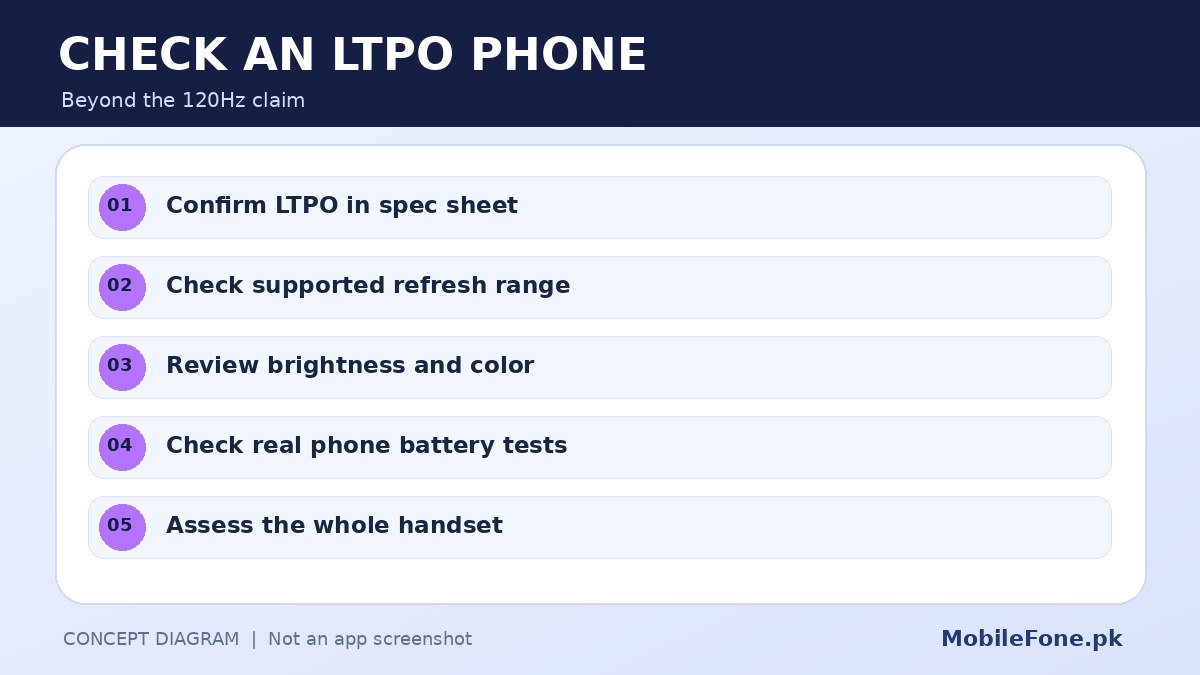
- Read the official specifications for the exact model and confirm that LTPO is mentioned.
- Look for the actual adaptive range and any restrictions in different modes.
- Check independent measurements of brightness and color, not just refresh rate.
- Watch real scrolling and video playback for smoothness and consistency.
- Consider chipset efficiency, battery size, resolution and screen-on behavior together.
In many cases the refresh range is adjusted automatically. Manually selecting a high-refresh mode may keep it enabled for more of the time, depending on software. A battery-saver setting may cap the maximum rate. Neither result means the screen is defective: the manufacturer often trades smoothness against power consumption depending on circumstances.
Storage and RAM still matter to the overall experience. A phone that stutters because of heavy background work will not become instantaneously fast because its panel supports 120Hz. When considering an upgrade, compare complete phone configurations, not a headline display term.
Buying guidance: LTPO is worth having when a smooth, efficient OLED screen is important to you, but it should sit alongside brightness, software, durability and battery-test evidence in your decision. Look for documented model-specific behavior rather than assuming every adaptive display offers the same range or savings.