Snapdragon vs MediaTek: How to Compare Chipsets

On this page
To compare Snapdragon and MediaTek chipsets, begin with the exact processor models—not the brand names. Qualcomm makes Snapdragon platforms, while MediaTek offers families including Dimensity and Helio. Both companies sell chips across very different price and performance levels. A flagship MediaTek processor may be much stronger than an entry-level Snapdragon, and the reverse can also be true. Your choice should be guided by the CPU, graphics, sustained performance, modem, efficiency and actual phone implementation.
Why the chipset name alone can mislead
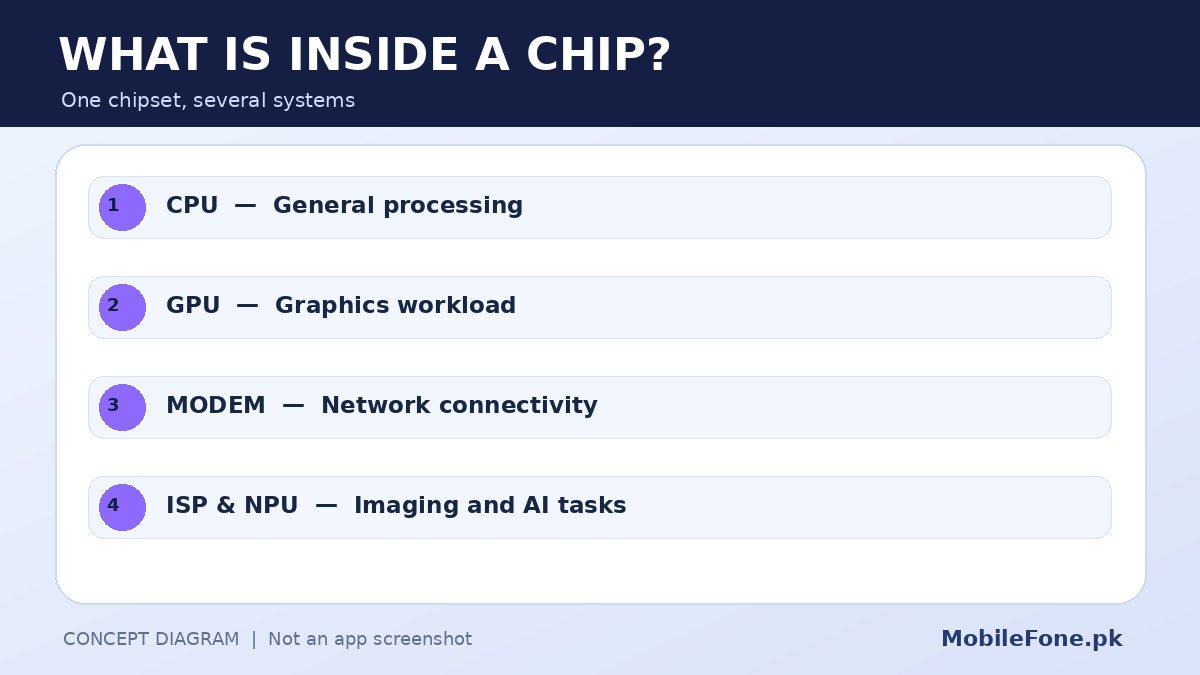
A smartphone system-on-chip, or SoC, contains more than a processor. It typically integrates CPU cores, a graphics processor, image-processing hardware, video functions, AI acceleration and communications components. Even the same chip can behave differently in two phones because cooling, battery limits and the manufacturer’s software influence sustained output.
Qualcomm’s Snapdragon 8 Elite specification page, for example, describes Oryon CPU technology, Adreno graphics and a dedicated cellular modem system. MediaTek’s Dimensity 9400 specifications show a different CPU design, Immortalis GPU, NPU and integrated connectivity capabilities. These illustrate different technical approaches, not a single universal winner; they are examples, not a claim that every chip from either brand shares those specifications.
| Component | Useful evidence | Buyer relevance |
|---|---|---|
| CPU | Core architecture, measured app performance | General speed, multitasking |
| GPU | Graphics architecture and game compatibility | Gaming and visual workloads |
| Sustained output | Longer test runs, thermal behavior | Extended games and recording |
| Modem | Supported regional bands and carrier features | Reliable mobile connectivity |
| Image processor | Supported camera and video functions | Photo processing possibilities |
| Efficiency | Independent device battery and heat tests | Daily comfort and endurance |
Gaming is about sustained speed, not one benchmark
Published CPU or GPU scores can provide a rough comparison when tests use the same version, conditions and device configuration. But a quick peak score may not represent performance after twenty minutes of gaming. Some handsets can hold higher frame rates because of better thermal management, even if another phone starts faster. Storage speed, RAM capacity and display settings can also affect perceived responsiveness.
A useful review should report which game, graphics settings, phone temperature and duration were tested. Avoid ’90 FPS guaranteed’ claims based only on the processor label. Game developers set device support individually, and performance can change with updates. When comparing models shown in MobileFone’s model directory, remember that RAM capacity is only one part of the experience.
Also look beyond demanding games. Many buyers want fast camera launching, dependable messaging, smooth maps and low idle power use. A well-tuned midrange processor may be a better match than a faster flagship chip if a lighter phone, lower price and manageable heat matter more.
Cameras, AI and network support differ by model
The camera specifications of a platform describe what it may support, not what a phone actually offers. A chipset may accept very high-resolution sensors, yet the handset can use a smaller sensor, lack optical stabilization or omit a particular video mode. The same caution applies to advertised AI capabilities: they depend on model-specific software, memory, language support and app implementation.
Similarly, 5G branding does not guarantee that all networks or bands work with an imported handset. Check the precise phone variant, operator bands and software enablement. The 5G-capable phone directory can help you find candidates, but the manufacturer and carrier should confirm which connection modes are supported locally.
- Daily use: prioritize responsiveness and software support over peak benchmark claims.
- Gaming: examine sustained graphics tests in the exact phone chassis.
- Photography: compare actual camera results and video modes, not the ISP’s theoretical maximum.
- Battery: use independent whole-phone tests under comparable conditions.
- Imported models: verify regional radio compatibility and network features.
A sensible comparison process for Pakistani buyers
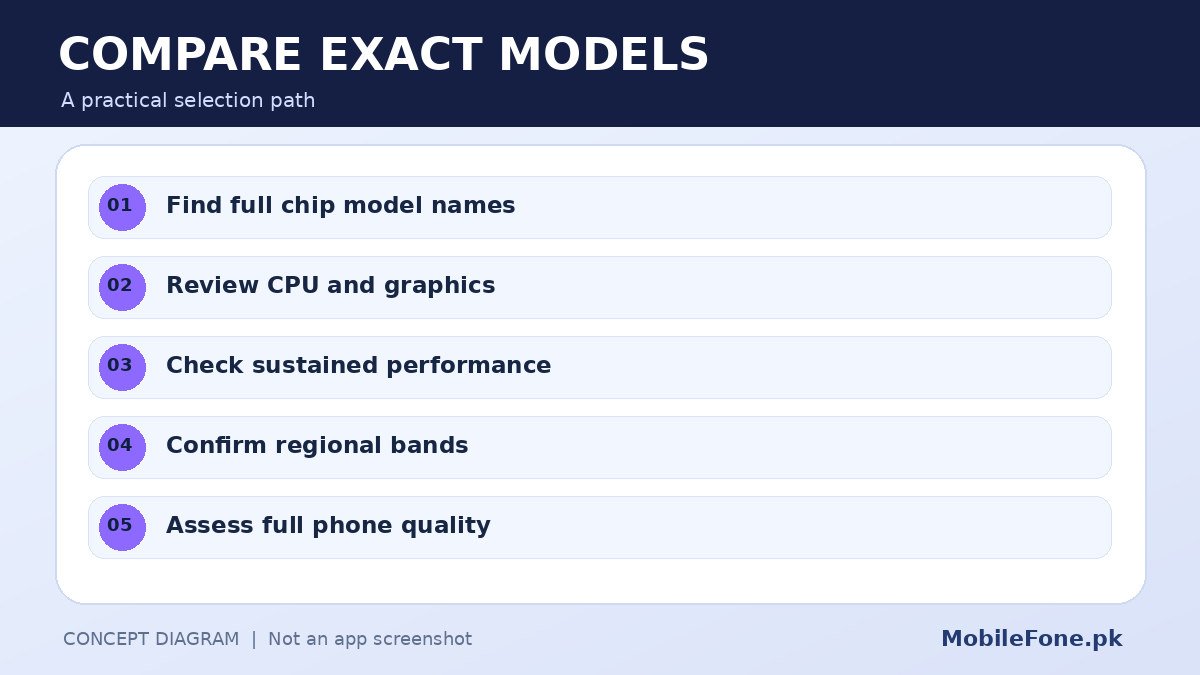
- Write down both complete phone names and their chipset model numbers.
- Find the official processor product pages for CPU, GPU, modem and memory support.
- Check the phone maker’s specifications for screen, storage type, cooling and update policy.
- Read comparable independent reviews testing longer games, video and battery use.
- Compare local seller warranty, PTA/device status, storage configuration and actual pricing separately.
Be careful when a retailer writes only ‘Snapdragon octa-core’ or ‘MediaTek gaming chip’. That label omits the single most useful detail: which specific part it is. Process naming can also span generations and tiers; two chips sharing a leading family number might be built for very different budgets. Qualcomm’s 2026 Snapdragon 6 and 4 series announcement itself demonstrates that different product tiers target different expectations.
What usually matters after you choose the processor
A good chip in a weakly configured handset can disappoint. Internal storage technology influences large app installations and loading, while adequate physical memory helps keep more apps available. Display brightness, speaker quality, modem tuning and the brand’s software maintenance also change daily experience. Assess the complete device, not only the SoC.
For a university student using browsing, videos and messaging, a stable midrange phone with reliable support may be the rational choice. A heavy gamer or mobile video editor will value sustained performance, good cooling and fast storage more. Someone in a marginal coverage area should pay special attention to the device’s actual cellular compatibility. These are decision criteria, not unverified rankings.
Recommendation: there is no automatic Snapdragon victory or MediaTek victory. Choose the more capable specific handset for your priorities and price. A trustworthy model-to-model comparison should be able to explain the result without relying on the chipset logo.