Refurbished vs Used vs Open-Box Phones

On this page
A used phone has had a previous owner, an open-box phone has been opened or returned but is not necessarily repaired, and a refurbished phone has undergone some stated inspection, repair or reconditioning process. None of those labels alone proves battery condition, original parts or warranty coverage. The useful question is not which word sounds best; it is who tested the actual handset, what was changed, what proof exists and what happens if it fails after purchase.
Understand what the three labels really tell you
In Pakistani shops, “like new,” “open box,” “refurbished,” “used” and “kit phone” are not consistently applied condition grades. A barely used device may be in excellent shape; a poorly refurbished one may have hidden replacement parts. Open-box packaging may be authentic or simply resealed. Ask the seller to describe the specific device rather than relying on its category. The clearest seller should be able to provide a written description and let you verify it.
| Label | What it usually means | What you still need to prove |
|---|---|---|
| Used | Previously owned or operated. | Damage, battery wear, account removal, warranty. |
| Open-box | Packaging opened; item may have been displayed or returned. | Actual use, accessories, activation and return conditions. |
| Seller-refurbished | Seller claims inspection or repairs. | Parts used, test results, technician, written coverage. |
| Manufacturer-certified refurbished | Brand-run program with documented standards where offered. | Exact regional program, eligibility and warranty terms. |
For comparison, Apple’s certified refurbished program describes testing, cleaning, genuine replacement parts when needed and specific warranty coverage. Samsung’s US Certified Re-Newed program describes a certified new battery and a limited manufacturer warranty. Those are examples of named programs in specific markets, not evidence that a shop in Pakistan provides the same service or terms.
Why a cheap “refurbished” label can hide expensive repairs
Ask what was repaired and why. A screen replacement, new battery or charging-board repair may be reasonable if documented and properly tested. The trouble begins when a seller uses “refurbished” as a substitute for that explanation. Parts provenance matters: an unknown screen may change brightness, touch sensitivity or fingerprint operation. On an iPhone, some repair information can appear in Parts and Service History; on a Galaxy, Samsung Members diagnostics can test selected hardware functions.
- Ask for evidence: receipts, service record or seller’s documented inspection checklist.
- Ask about parts: original, genuine manufacturer-sourced, salvaged or third-party replacements.
- Ask about warranty: who provides it, duration, coverage, exclusions and claims process.
- Ask about returns: whether the device can be rejected after a meaningful test.
- Ask about ownership: whether Google/Samsung or Apple account locks are fully cleared.
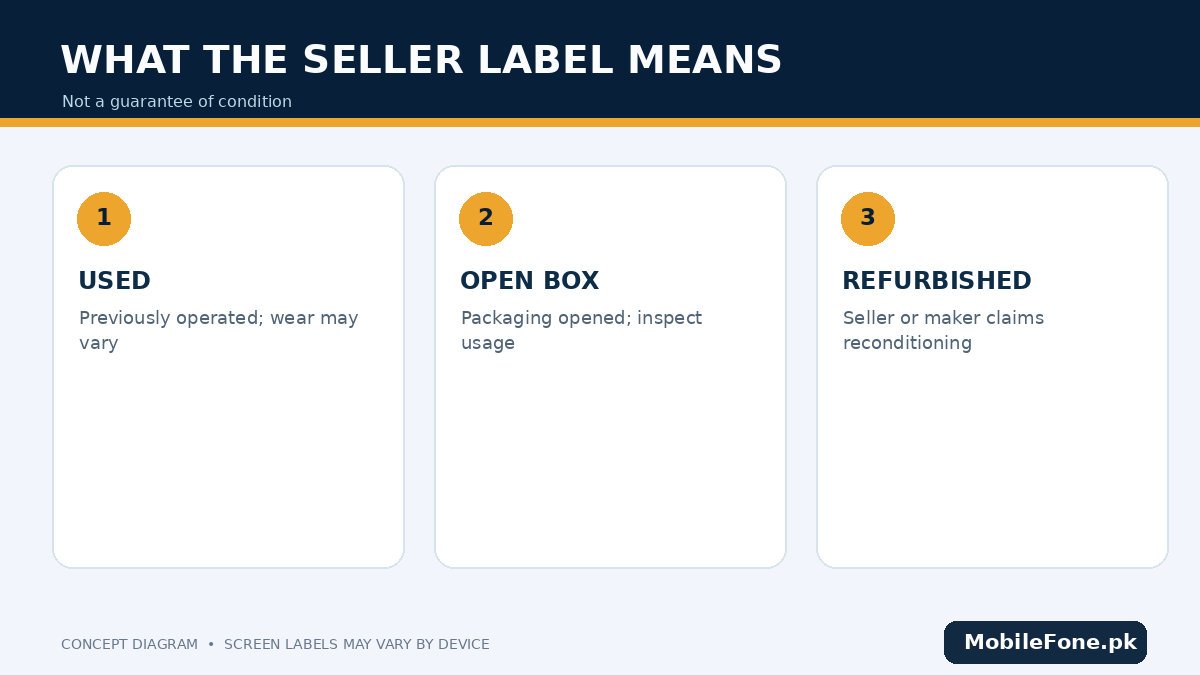
Open-box is not automatically unused
A store demonstration phone, customer return or display model may have little visible wear but a meaningful number of battery cycles, charging hours or cosmetic marks. An open box also does not mean the advertised accessories are present. Request the original purchase record and inspect whether the charger and cable are appropriate for the specific phone. Do not assume a replaced shrink wrap indicates factory packaging or that warranty starts on the day you buy it.
Use the same functional checks you would apply to a used phone: screen, cameras, battery, calling, mobile data, microphone, speaker, Wi-Fi, charging and account ownership. For Samsung, the manufacturer’s Samsung Members diagnostics guide is a practical starting point. For iPhone, Apple’s pre-owned inspection guidance places particular emphasis on Activation Lock and parts history.
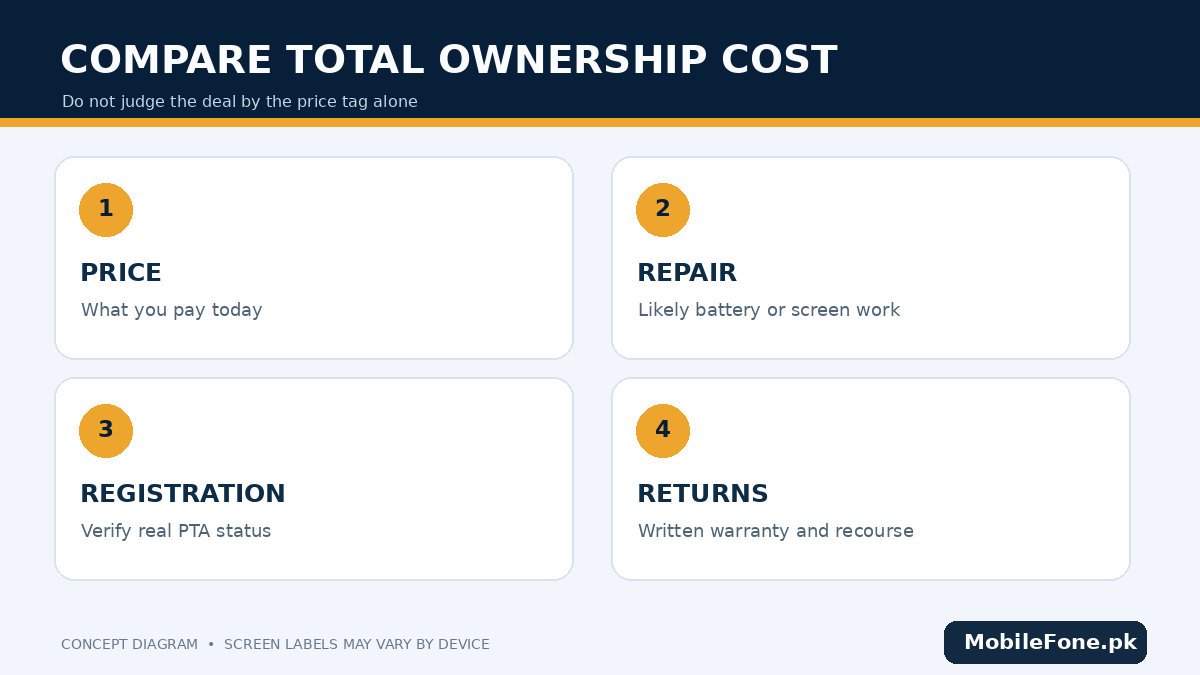
Factor PTA status, import version and warranty into total cost
A low asking price can be misleading if the handset cannot use local cellular networks. Before paying, verify relevant IMEIs through the official PTA/DIRBS procedure; do not treat a printed “PTA Approved” sticker as proof. The government’s DIRBS documentation describes public IMEI verification, including SMS to 8484. Also check which regional model you are buying, because network bands and eSIM configurations can differ. Never share full IMEIs or identity documents in public posts.
Build a simple total-cost estimate: asking price + predictable repair cost + potential registration costs + accessory replacement. Do not invent a PTA tax amount from a generic online chart; any applicable charge must be checked through the official mechanism for the actual device. Compare this total against a new phone with a verifiable local warranty and reliable return terms. The phones under Rs. 50,000 directory is a useful comparison starting point, provided you reconfirm current stock and pricing.
Which condition should different buyers choose?
A buyer who wants the simplest after-sales support should normally prioritize a new phone with a clearly documented local warranty, or a genuine manufacturer-certified program where it is officially available in the buyer’s region. A careful buyer comfortable with inspections may find a properly documented used handset worthwhile. An open-box model may offer good value only if its original condition and return rights can actually be checked. “Refurbished” becomes attractive when there is credible evidence of the process, not just a lower price on a banner.
| Your priority | Look for | Do not overlook |
|---|---|---|
| Least uncertainty | New/local warranty or documented certified program. | Region-specific warranty applicability. |
| Lowest upfront cost | Transparent used device with hands-on testing. | Battery and screen replacement expenses. |
| Near-new appearance | Open-box item with return rights. | Past activation and accessory completeness. |
| Repaired flagship | Written refurbishment and parts records. | Repair workmanship and future support. |
A practical handover checklist before payment
- Verify exact model, storage, color and regional version from on-device settings.
- Run the relevant hardware checks and use your own SIM for a call and data test.
- Confirm every IMEI’s current regulatory status and carrier compatibility.
- Require legitimate removal of Apple, Google and Samsung accounts as applicable.
- Read the receipt, return terms and warranty coverage before transferring payment.
- Decline a sale if important tests or ownership checks are refused.
When you need to compare specifications rather than a seller’s marketing grade, use the MobileFone model directory. It can show what a model was designed to offer, not whether an individual unit was repaired, damaged or previously blocked. That distinction matters more than a polished listing photo.
The simplest buying rule is to pay for demonstrated condition and enforceable seller terms, not a reassuring label. If documentation is missing, reduce your confidence rather than inventing a bargain. A predictable phone with a fair return policy is often better value than a cheap one whose risks remain invisible.

Related reading
 Mobile Buying GuidesMobile Buying Checklist for Pakistani BuyersNovember 14, 2026
 Mobile Buying GuidesHow to Inspect a Used Samsung Phone Before BuyingNovember 14, 2026
 Mobile Buying GuidesHow to Inspect a Used iPhone Before BuyingNovember 14, 2026
 Mobile Buying GuidesHow to Check a Used Phone’s Battery ConditionNovember 14, 2026