How to Check an Imported Phone Before Buying

On this page
- Start with the phone in your hands, not the advertisement
- Which claims should you verify before paying?
- Check PTA status on every IMEI
- Match the imported variant to the buyer’s actual needs
- Check ownership locks, battery condition and seller evidence
- Work out the total cost, not just the sticker price
- When should you walk away?
Before buying an imported phone in Pakistan, check the actual handset’s IMEI or IMEIs through PTA’s device verification service, compare its model and serial details with the seller’s paperwork, and test it with a local SIM. Do this before paying, not after the seller has left. A phone described as factory unlocked, international, or even PTA approved is not automatically registered for use on Pakistani networks. Registration, network compatibility, ownership locks and physical condition are separate checks.
Start with the phone in your hands, not the advertisement
Ask the seller to power on the exact handset you will receive. Dial *#06# in its phone app and note the IMEI numbers displayed. Many dual-SIM and eSIM-capable devices report two IMEIs; record each one. A printed number on a box or listing is not enough because boxes and handsets can be separated or mismatched. Compare the on-screen numbers against the available box label, invoice and any device information screen.
The Pakistan Telecommunication Authority’s DIRBS standard operating procedure describes device verification by IMEI, including SMS to 8484. Send each IMEI separately using your own local SIM or use an official PTA verification channel. Read the full reply, not just a screenshot showing a green check on someone else’s phone. A query establishes the reported status at that moment, not a permanent warranty against future problems.
Never publish the full IMEI in a public marketplace comment or share a verification OTP, login credentials or CNIC photo with an unknown seller. Keep transaction and identification information private.

Which claims should you verify before paying?
| Seller’s claim | Your independent check | Why it matters |
|---|---|---|
| PTA approved | Check every IMEI via official device verification | Approval is device-specific, not a brand guarantee |
| Factory unlocked | Try a functioning local SIM and make a call | Carrier locking differs from PTA compliance |
| Original global variant | Compare model number with manufacturer specifications | Imported variants can differ in bands and hardware |
| Never repaired | Inspect screws, seams, display, cameras and charging | A software status cannot prove physical condition |
| Tax already paid | Ask for verifiable official evidence and check PTA status | A verbal promise is not a payment record |
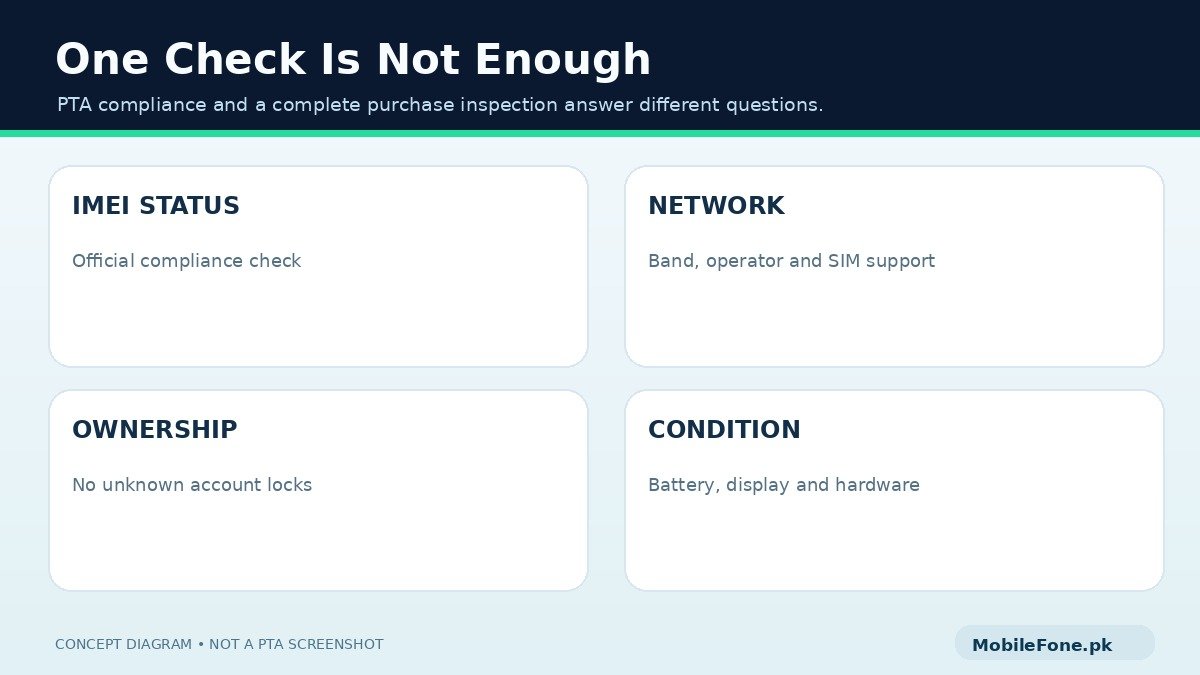
This separates three issues often confused in shop conversations: an IMEI may be technically valid, a device may or may not be registered with PTA, and its network bands may or may not suit your operator. Passing one test does not automatically pass the other two. Our editorial verification policy makes the same distinction between a model listing and the registration status of an individual handset.
Check PTA status on every IMEI
- Open the handset’s dialer and enter *#06#; capture IMEI 1 and IMEI 2 where present.
- Check the identifiers through PTA’s documented 8484 SMS route or the current official Device Verification System.
- Read the complete response. Look for language such as compliant, valid but not registered, non-compliant or blocked rather than treating all replies as the same.
- If there is a second IMEI, repeat the check. One satisfactory reply does not clear the second identifier.
- Keep a dated record of the replies with your purchase receipt, without exposing the numbers publicly.
A valid but not registered reply must not be advertised as fully approved. Similarly, a phone might currently accept a SIM while its status still requires action. For the authoritative current registration route and eligibility rules, consult the Federal Board of Revenue’s DIRBS information page. Do not rely on old screenshots that promise a universal grace period or a fixed fee; circumstances and rules can change.
Match the imported variant to the buyer’s actual needs
Look up the complete model code rather than a marketing name such as ‘Pro’, ‘Global’ or ‘5G’. Two phones with similar names can carry different modem bands, storage configurations or software versions. Compare the manufacturer’s regional specification sheet with the operator technology available where you live. Support for 5G on the box does not prove 5G service is available on your SIM and network, and PTA compliance is not a radio compatibility test.
Inspect Settings for storage capacity, operating-system version and security update information. These details should agree with the seller’s claims. An unsupported device with outdated software can be a poor long-term choice even when the hardware is attractive. Compare alternative models and published specifications in our mobile prices and specifications directory, but still verify the actual unit’s IMEIs independently.
Check wireless connectivity, speakers and microphone, both cameras, autofocus, display touch response, fingerprint or face unlock, charging port and any eSIM activation requirements. Use a normal SIM with permission and test calls, SMS and mobile data where possible. A data connection alone cannot prove every advertised feature works, but these basic checks often reveal costly surprises.
Check ownership locks, battery condition and seller evidence
Ask the seller to demonstrate that the device can be signed out of its previous accounts. On iPhone, Activation Lock can prevent a new owner from setting up an erased device. Android phones may require a previously synced Google account after an unauthorized reset because of factory-reset protection. Do not hand over payment until the device is legitimately ready for a new owner. Avoid bypass services or tools advertised to defeat security locks.
Battery health deserves its own conversation. Some phones display battery health or cycle data; others do not. Fast battery drain, overheating, a raised display and inconsistent charging need further assessment. A swollen battery is a safety issue: do not continue charging or pressing the casing. Seek professional inspection instead of treating the problem as a price-negotiation point.
Get an itemized invoice that identifies the actual model, storage variant, colour, condition, seller, date, return arrangement and the handset’s identifiers where legally appropriate. Confirm whether warranty coverage is an official Pakistan warranty, a seller warranty, or none at all. A box, charger and attractive condition cannot replace written terms.
Work out the total cost, not just the sticker price
An imported device offered below the usual market price may need registration-related payment, repair, a replacement battery or accessories. Ask whether any outstanding customs duties or taxes are already included and what official document supports that statement. FBR, rather than an anonymous social-media tax chart, is the starting point for finding current rules and duty information. Never pay a supposed PTA tax into a stranger’s personal wallet on the strength of a text message.
For a quick decision, split the cost into purchase price + verified official charges + essential repairs + warranty risk. If two sellers offer similar phones but only one can demonstrate clean IMEI verification and proper ownership transfer, the cheaper price may not represent better value. If critical proof is missing, request time to check it or leave the purchase.
When should you walk away?
- The seller refuses to open the dialer, show both IMEIs or let you verify them yourself.
- The on-screen identifier does not match the available transaction documents and the mismatch has no credible explanation.
- A PTA reply reports non-compliant, blocked, duplicated or otherwise problematic status without a documented resolution path.
- The handset is locked to an unknown account, or the seller proposes unauthorized software alteration or IMEI patching.
- The seller insists that a pending tax payment is already cleared but cannot provide evidence or lets you check only after payment.
Take the extra few minutes at the counter. The best imported-phone deal is one whose identity, network status, condition and final cost can all be checked before money changes hands.

Related reading
 PTA & Mobile RegistrationHow to Check PTA Approval Using an IMEINovember 14, 2026
 PTA & Mobile RegistrationHow to Find an IMEI on Android and iPhoneNovember 14, 2026
 PTA & Mobile RegistrationPTA Compliant vs Non-Compliant Mobile: What It MeansNovember 14, 2026
 PTA & Mobile RegistrationHow Mobile Registration Works Through DIRBSNovember 14, 2026